“Where do you see yourself ten years from now”, remember this question? Does this remind you of something that you have always wanted to attend but dreaded to face? Yes it is one of the many questions that we all have faced while attending interviews for various posts in various stage of our life. Well the answers have always been tweaked and changed in ad hoc manner to suite the expectations of our prospective employers and their interviewing panel.
Very rarely have we given a thought to the particular question, once the interview session, got over as to what we really want to do in our life and where we would like to be by our late or mid 40s. How would we like to see ourselves placed in life when we are at a critical juncture of our life where we are in the mid senior or senior level position in our profession?
Take a survey and you would be surprised to see that around 30% to 40% of the people who are searching for their first job would state that they would cross the bridge when they come to it. They prefer staying in the present and enjoy every moment of it. No, I am not indicating that they come in the category of hedonists. Neither would I say that they are not smart enough to not take the right decision. I would not do the mistake of underestimating them as they know what they are doing and are at least two steps ahead of us when it comes to planning and execution.
It is just that they would like to take one step at a time and plan each and every move carefully to make sure that their rate of success is higher. And there is nothing wrong in what they are thinking.
Out of the rest of 70% to 60% around 40% people are the research scholars and PHD holders and professors of the world. The remaining are the ones who have already planned to become an entrepreneur at some stage of their life. They have their plans ready and are waiting for the right time to execute their plans.
You would usually see them with people who are like minded and always discussing various options available to start something on their own. They are usually bursting with new ideas and each of their plans have a scope of yielding profit within 6 months to one year of their inception.
Again, there is no harm in being optimistic and enthusiastic about your future plans but there needs to be some realistic planning and some amount of pragmatism which is supported with a plan B which is usually a backup plan. You do not need to have multiple back up plans as the chances of your Plan C or Plan D failing or not succeeding is equally high if your plan A and B fails.
We need to understand that each and every backup plan needs the same amount of attention and planning as our main business plan as they will take over if the initial plan fails. So, if we are spending a majority of our time in planning backups then we will be busy creating backup for backup and we will always be in planning mode. Planning is important but so is execution of those planning.
How funny it is that majority of people who acquire an MBA degree end up working for a person who owns a business. Doesn’t MBA mean Masters of Business Administrations? So shouldn’t majority of MBA students become an entrepreneur? But that is not the case? Have we ever given a thought to it as to why does an MBA student more often than not prefers being an employee rather than an employer?
The answer to it is not lack of ideas but the type of knowledge that is provided in these courses. An MBA student is taught how to handle complex analytical problems and statistically plan. They are excellent solution providers to a problem. They know the answer to all the how’s but have never taken out time to think about the why. So in a nutshell you do not need to have an MBA degree to start your own business.
Let’s do some basic research on business. Let us understand what business actually is.
So the very obvious question to start will be…
What is business? I tried searching for the meaning fo business and as usual tried to Google the meaning of business. I came through a link of Webster's Dictionary and when I looked into it out of curiosity to find out what does it say then I was kind of surprised to find out that very simply stated business is the state of being busy. It is a common English language meaning for the word, but it is more to it than what actually meets the eyes. Business is actually a dream of the people who dare to think out of the box. It is a dream of the people who are willing to go that extra mile and take the risk of doing something which is unconventional. It is the passion for people who dare to think why instead of thinking how.
Walt Disney once said "If you can dream it, you can do it". Well now all the people in the world have dreams and they dream it every day of their life. Then what is the difference between dreams of an Entrepreneur and the others. No difference at all. All the people want to do something on their own and want to become rich and famous. Take a survey and you will hardly find a parson who will say that he or she dreams to be a successful employee. Everyone dreams of doing something of their own at some point of their life.
But only a few of them have the courage to go out of the league and start a business of their own.
This reminds me of the four quadrants mentioned by Robert Kiosaki in his very famous book called CASHFLOW QUADRANTS. Where he talks about
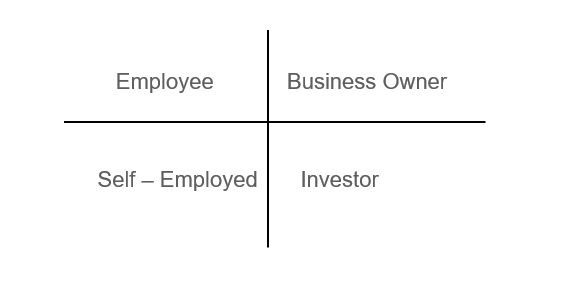
No, I am not going to deviate from the core topic and try to analyze the points mentioned by the great man himself. The reason for mentioning the four quadrant is that many people want to jump from the first quadrant to the quadrant of Business Owners without doing proper homework and end up in the third quadrant of Self-Employed and or go back to the first quadrant of Employee after suffering huge loss.
No, I am not asking you to stop dreaming of starting something on your own and join the league of the rich and famous all around the world. You need to hold on to your dreams, and believe that you can thinking that nothing is going to stop you from being successful in your venture. But the unfortunate part is that just by holding on to the dreams they do not come true. A lot of hard work and home work is needed to start a business.
All the entrepreneurs dream to have a successful business, but still majority of startups fail. I remember reading an article in Forbes where it was mentioned that nine out of every ten startups fail. That is a whopping 90 per cent. That forced me to think as to why do majority of startups fail? Why is the rate of failure so high? Where do they go wrong?
I did a lot of research to come up with the following major reasons for the start ups failing. Tried to point out just those five points that is the pivot around which both failure and success depends. The thin line which differentiates success and failure when it comes to starting a business, and here are the points that I feel are the major players that decides failure and success when it comes to starting a business.
Well some might differ from my point of view and state that there are other factors which can also be the reason for failure and success and I do not deny that. That are many factors which play important roles but I have taken these four points which I feel can make or break your business.
*Ground work and planning- Idea, Idea everywhere but not helping succeed. That is what the actual situation of all the wannabees entrepreneurs. Everyone has a wonderful idea which is a sure shot success on the paper. The planning is fool proof and guarantees hundred percent successes. Shows no flaws and is very easy to execute as all the finer points are taken care of while the planning is done. But when it comes to auctioning it out the plan fails miserably. Why? Simply because no or not adequate groundwork was done before implementing the idea.
An Idea is like a seed. A seed has a potential to grow into a big tree but just a potential is not the only factor for it to transform from a seed to a big tree. The correct soil needs to be chosen. The soil needs to be curetted and the right type of manure needs to be used in order to get the desired result. You cannot just sow the seed and expect the seed to grow into a tree on its own.
Your business idea is just like a seed. You need to first understand the market that is there for your business. The first thing that you need to do is come out of the mythical bubble that your idea is unique. Someone somewhere in this world would have got the same idea and would have already tried it out. It is not important whether your idea is unique or not. If uniqueness is the only factor for success then there would not be multiple brands of the same products al around the world and there would have been only one service provider for each and every type of service. So do not worry about the uniqueness of your product or service. What you need to worry about is the uniqueness of the way it is being implemented. And for that you need to understand the market and understand where and how you can implement your idea and the where here is the soil and how is the curetting work that needs to be done in order for your business to be successful.
* Team players and not Individual contributor– Business is not a one man’s show. You cannot afford to do everything on your own.
It is impossible to be a one man army. As an owner of the company you can only do so much and you will need a team to handle other responsibilities. You need to have a group of people who are performing different activities in order for you to run your business successfully. That is why a company is also known as an organization, a group of people performing various activities towards achieving the same goal or purpose. It is very important to have the right kind of people in the team.
As per a survey, around 37% of the founders feel that getting a right team set up is the biggest challenge faced by startups across the world.
It is obvious that being the owner of the company you might be apprehensive about trusting your team from day one and would try to keep some amount of control with you. But it is very important that you trust your team's ability and give them enough control in their area of responsibility.
We need to keep in mind that individual success does not matter if the team as a whole is failing. Rather than having individual brilliance in the team we need to make sure that we have good team players who can work around each others' strengths and weaknesses.
You need to have a mixed approach of centralized and decentralized power mechanism. That means you do need to have certain powers and controls under you but you need to give your team a certain amount of power in order for them to be able to execute their work freely.
You cannot expect your team to seek your approval for each and every activity. If that is the case then it is high time you change your team because you will be sucked into day to day operational activity and you will not be able to focus on your own work.
* Control of Cash Flow- One can say that Cash is not the be all and end all when it comes to starting a business but it is very difficult to start and run a business without cash too. Around 13 per cent around the globe feel that start ups run out of steam just because it has run out of cash flow.
It is not true that all startups or business failing because of loss or insolvency. There are many businesses which had to be closed as there was not enough cash flow to continue. One needs to understand the stark difference between urgent and important, important and not urgent features of the business.
Important and urgent features are ones which are needed to run the day to day activities of the business. Important and not urgent are the ones which are better to have features which can be acquired once the business settles down. Once you are able to differentiate between these features and make a clear demarcation then it becomes a bit easier to control your cash flow. Yes, there will be contingencies and unforeseen events which will make you to spend more than you plan to spend but there will be an overall better control over your cash flow.
*Not ready for expansion- There are three stages of any business. Start up state, steady state and growth state. You can use the same business model for both start up stage and steady stage. But there will be a time when you will need to expand or grow your business. You need to forecast and make provisions for growth in your business model or else you are bound to fail. Doesn’t matter how successful you have been in the beginning stages, if your business model is not flexible enough to accept changes then your business will fail in due course of time.
It has been observed that around 10% of startups have failed, in spite of having a great start, because they were not flexible enough to scale up at the right time.
*Ignoring the competitors- When I was a child my mother used to tell me not to bother about the so called competitors and just concentrate on my studies. And I was bound to succeed. According to her thinking about my competitors would distract me from my studies and I would end up being second best.
But the same philosophy cannot be applied in the world of business. World of business has changed drastically in the past decade or so. It is virtually impossible to have an idea so unique that you have no competitors at all. So it will be fool hardy to think that your idea is the first and take the market by storm, or to think that your product or service is the best in the market and cannot be matched by your competitors.
The biggest risk would be to enter into a business without doing a proper stud of the market and your competitors. And around 19 per cent of the entrepreneurs fail due to this mistake.
*Not understanding the mood of the market- The biggest challenge faced by startups or business owners is that they do not take out time to study the market. The product offered by them might excellent but is it going to attract the customer? What will be the target customers? What are their needs? Is your product actually fulfilling their need? These are some questions that need to be answered before launching your product in the market. That is the right approach. Unfortunately many entrepreneurs develop the product and then talk to their customers and struggle to sell their product as it does not cater to the need of the customer.
Venture Capitalists have a very bad reputation across the world. They are known as cold heartless people who are very hard to convince. It is true that a large number of ideas and ventures fail to get funding because the entrepreneurs are not able to convince Venture Capitalists that their idea has a higher rate of success in the market.
It is very easy to blame a VC for not funding a project but have we ever thought the reasons for rejections from the VC's angle? Have we ever done some homework on what VC is all about? Even before we plan on approaching a VC with the business proposal we need to do some homework from our side.
We need to understand what venture capital actually is. What does it involve? What are the various stages of funding? And last but not the least the elements considered by the venture capitalists before approving or rejecting funding.
What is Venture Capital?
Venture Capital is the financial assistance provided by experts who are willing to invest in companies which are young and have the potential to grow rapidly into significant economic contributors. As per the SEBI regulations, venture capital fund is defined as a fund that is established in the form of a company or trust that raises money through loans, donations, issuing securities or units, in order to make investments in accordance with these regulations.
Who are Venture Capitalists?
Venture Capitalists are individuals or companies providing Investment Capital, Management Expertise, and various kind of support which includes and is not restricted to networking and marketing.
The focus areas of Venture Capitalists are as follows
* Providing financial support for new and rapidly growing organizations
* Purchasing equity securities
* Creating a framework for a long term plan (generally involving a time frame of around 5 to 6 years or more)
* Active participation in the company's management and strategic planning related to the overall growth and functioning of the project of the company
* Networking and marketing of the product and or services that are being offered by the company.
* Taking high risk to increase profit margins and get higher rewords.
So the work of a venture capitalist does not end with providing the financial support to the organization. In fact it can be said that providing funds is the first of many steps taken by a venture capitalist.
In this segment we have tried to understand what venture capital is and the areas that are covered by venture capitalists while funding an organization. In the next segment of this topic we will be focusing on the various stages of funding.
The funding provided by VCs varies across different stages of the growth of the firms that it is investing in.
The stages are as follows:
Pre Seed Stage: As the name suggests this is the first stage of funding and can also be taken as a token amount provided as capital to kick start and market a potential idea that has good future prospects. This also covers the development work of the product to some extent.
Seed Stage: The actual and full time involvement of Venture Capitalists in the business starts from this stage that is the Seed stage. This is the stage when financing is provided to complete the development of the product and commence the formalities of marketing.
Early Stage or the First Stage: In this stage companies are provided with financing for initiating commercial manufacturing and sales of the product.
Second Stage: This is the stage where growth and expansion of the business starts in terms of growth in accounts receivable and inventory. Financing is provided to companies to focus on those areas for growth.
Third Stage: By the time the third stage comes the companies have already reached the state of break even point. That means the company has come to the stage where the total revenue equals its total cost or expenses. Funding at this stage is provided with the sole intention of major expansion and increase in sales volume.
Later Stage Financing or the Bridge/Mezzanine financing: This stage of financing is usually done before the company goes IPO (Initial Public Offer). This is the time when the company plans to go public. It is structured in a way that it can be repaid in the form of proceeds received from the public offerings.
Now that we have gone through the different stages of financing we will try to understand the key elements that venture capitalists study before financing an organization. We will be covering this topic in our next segment.
In this section we will be covering the key elements that are studied by the venture capitalists before financing an organization. This is the most important section as it covers the points that emerging entrepreneurs must keep in mind while to approach Venture Capitalists for funding. Apart from the idea being brilliant and unique if these factors are covered then more often than not the funding is sanctioned.
Management Team: Management team is the team which is the face of the company. Speculations regarding the success and failure of the companies are made depending upon the members of the management team. They are supposed to be the key stakeholders of the organization and their strength and expertise bring a significant amount of credibility to the company. It is very important that the members are mature, have experience and possess working knowledge of the business, are team players and are capable of taking potentially high risks.
Capital Gain Potential: While funding an organization Venture capitalists look for an above average return of about 30-40 per cent. The rate of return cannot be fixed at a particular number as it depends upon the stage of the business cycle where the funding is done. The rate of return is directly proportionate to the risk and the risk is depending upon the stage. So the earlier the stage, higher is the risk and so are the returns.
Realistic view of the company's financial requirements and projections: While mulling over the prospects of financing a company the venture capitalists look for a realistic picture of the financial health of the organization. They also look for future projections regarding the scope, nature and performance of the company in terms of operational scalability, operating profit and research and development cost and cost of production development. Any information which is blown out of proportion and or falsely presented might hamper the prospects of funding being approved by VCs.
Financial stake of the Owner: Owner's financial stake is the finance provided by the owner from his personal sources. These sources include funds invested by family, friends and relatives. It plays a very important role in increasing the viability of the business and is a very important avenue where the venture capitalist is looking at.
It is very important that all the factors related to the above mentioned four points are defined thoroughly without any ambiguity before approaching Venture Capitalists. The chance of getting funding depends a lot upon how well these points are covered and defined in details.
Always remember that there are many hopeful applicants who try to get funding from Venture Capitalists and the window of opportunity is very small. The first meeting is very important and can be the game changer if prepared properly. In this article, which was divided into three parts, I tried to cover all the basics regarding Venture Capitalists. Hope this information helps you prepare yourself before contacting a venture capitalist for funding your business
